Resident guests
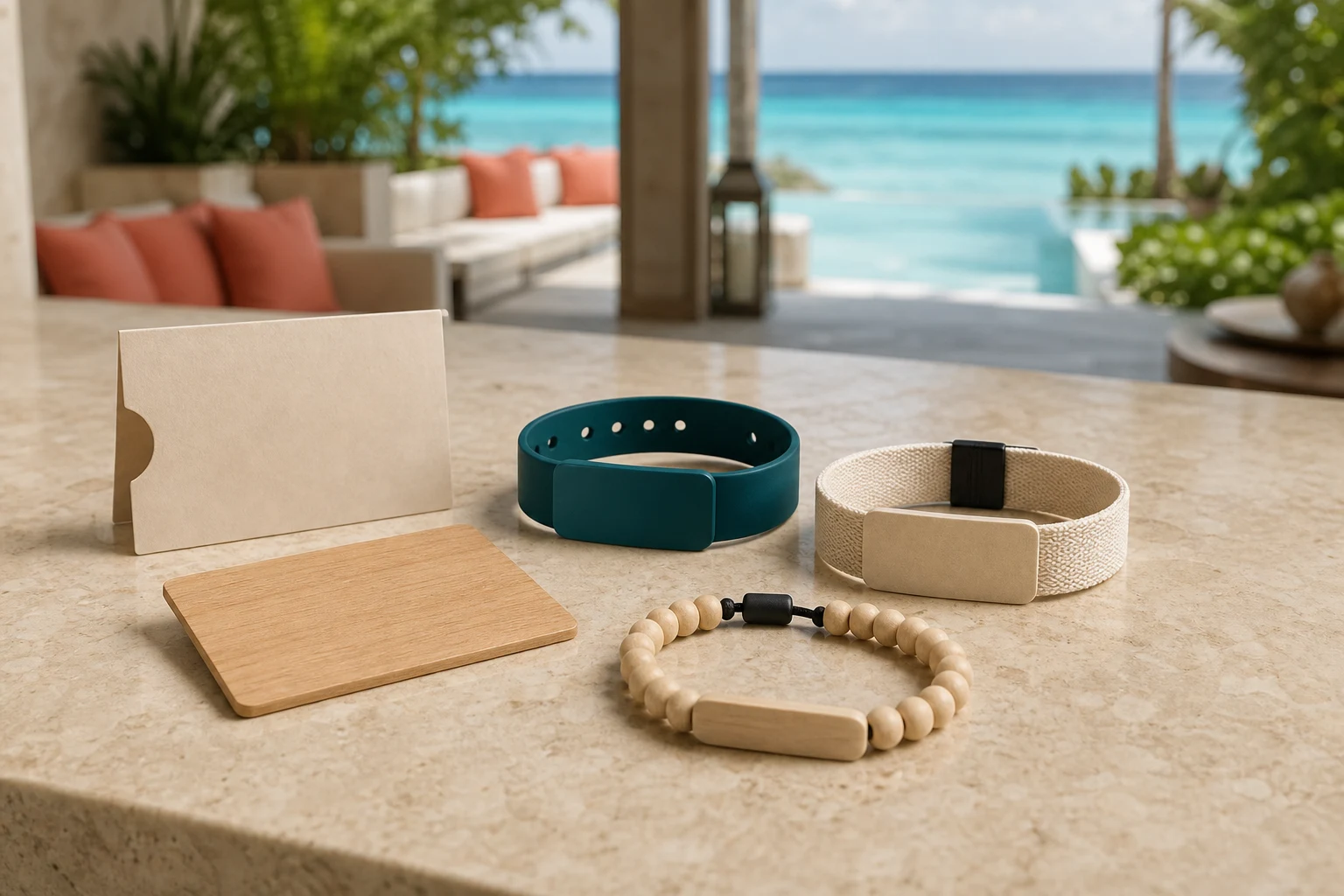
A room card for the accommodation and a water-facing band for pools, beaches and marina areas.
Island / Bahamas
Bahamian resorts tend to be large, water-facing and physically dispersed, with marina and cruise traffic on top of resident guests. Credentials get issued in volume, used in salt water and presented at readers far apart from each other.
Volume issue without a front-desk bottleneck
Continuous salt-water exposure as normal duty
Consistent reads across dispersed reader points
Operating reality
Product and specification decisions follow how the island's properties actually run.
A room card for the accommodation and a water-facing band for pools, beaches and marina areas.
A short-duration credential distinct on sight from the resident band, issued in bursts.
Consistent chip placement across the run so the tap gesture works the same at every point on the property.
Single-use credentials for shore-excursion and day-facility access, numbered for reconciliation.
RFID products
The card remains the familiar room credential; the wristband carries access into wet and high-movement areas. We manufacture each for its own exposure and issue routine.
Our Bahamas RFID key cards begin with the installed room system and a working credential, not with a tropical artwork theme. Where CR80 is required, the manufactured card is 85.6 × 54 mm and 0.76 mm, with the front, reverse, numbering area and finish approved together. Recycled-content PVC provides a consistent printed body for high-turnover room stock, while a natural material direction needs a separate handling and finish decision. We confirm 125 kHz LF or 13.56 MHz HF/NFC before production. The room card should remain distinct from marina, day-visitor and pool credentials so front-desk staff do not have to infer the product from a serial number.
We manufacture Bahamas RFID wristbands with wet use treated as the normal condition. Silicone bodies, controlled closures and clearly separated colourways support resident, marina and day-visitor populations without asking staff to scan every band merely to identify the group. The RFID construction and presentation point are tested on the property's readers because a beach gate, bar reader and room-side device may ask for different hand movements even when they use the same credential platform. Factory-applied numbering can support reconciliation where required. A paper-adjacent or slow-drying body is wrong for continuous sea and pool exposure, regardless of how attractive the printed sample looks when dry.
Compatibility and encoding remain conditional on the installed system and the approved working sample.
Detail
On a Bahamian property the band is in the sea most days. That rules out the paper-adjacent materials for anything longer than a day and pushes the specification towards silicone or braided marine cord, where wet is the normal state rather than an exposure event. It also argues for keeping the electronics in a sealed module or closure rather than in the band body.
When a guest presents a credential at a beach bar, a pool gate and a room door in one afternoon, all three readers are mounted differently. A run where chip placement varies between batches produces intermittent failures that look like a system fault and are actually a manufacturing one. We hold placement consistent across a run and read an encoded sample on the property's own readers before production for exactly this reason.
Large resorts issue in waves as flights land. Anything that adds seconds per guest — fitting a band that needs sizing, writing a number by hand, printing a room number onto a card at the desk — multiplies by the arrival curve. Factory numbering and a closure the desk can fit in one motion are worth more here than they are at a small property.
Technical depth
These are manufacturing controls, not assumed functions of a hotel system.
A credential can pass a bench read and still feel inconsistent when the electronics sit differently in a wristband, card or reader housing. We ask the property to test a production-representative sample at room, gate and amenity points included in the brief. The result records the credential technology, module position, intended presentation face and any operational instruction staff need to give guests. We do not infer read distance or universal reader behaviour. Consistent placement across the manufactured run is the controllable requirement, and the retained sample is the reference used when the next run is released.
A multi-island or multi-building operation should not receive one mixed carton of visually similar products. We can pack room cards, resident wristbands and short-duration bands in labelled lots tied to the approved artwork and numbering range. The order record identifies the receiving property or stock owner without promising customs treatment or transit time. If stock moves internally after receipt, the property controls that transfer. This packing discipline makes a discrepancy traceable to a product, range and carton, and it prevents emergency issue desks from opening the wrong credential population simply because the exterior colour appears close.
Market updateBahamas tourism growth: distributed RFID stock control ↗
Wrong fit
A hotel key card is wrong as the only Bahamas credential when guests repeatedly move through pools, beaches and marina areas. A textile wristband is wrong for continuous salt-water use unless its wet performance and closure have been approved from a real sample. Exposure decides the body before artwork begins.
Confirm the product ↗Build the brief
Share the property, destination, product direction and any system information already available. Your details stay in your browser — the button opens a pre-filled email in your own mail app.
Plan the order ↗