Product / Key cards
The familiar hotel format, controlled as a complete access product.
Classic hotel key cards provide a familiar issue experience and a broad artwork surface. Card body, credential, encoding responsibility and finish are confirmed together before the production run is released.
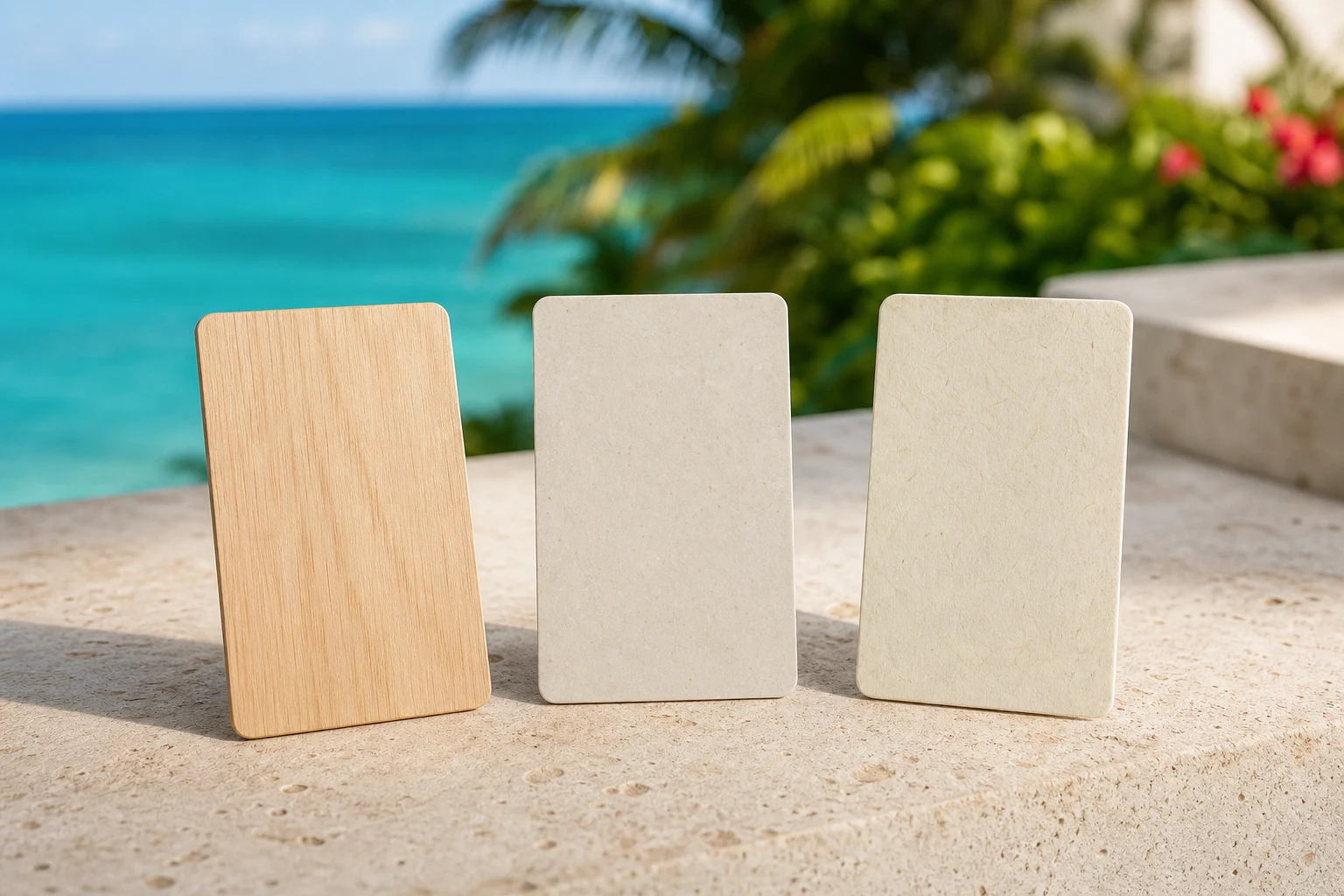
Card body and surface finish
Credential and encoding requirement
Artwork and variable data
Original product studies
Context at scale.
Construction up close.
Each image is an original illustrative product study created for this range. The approved production sample remains the controlling reference.
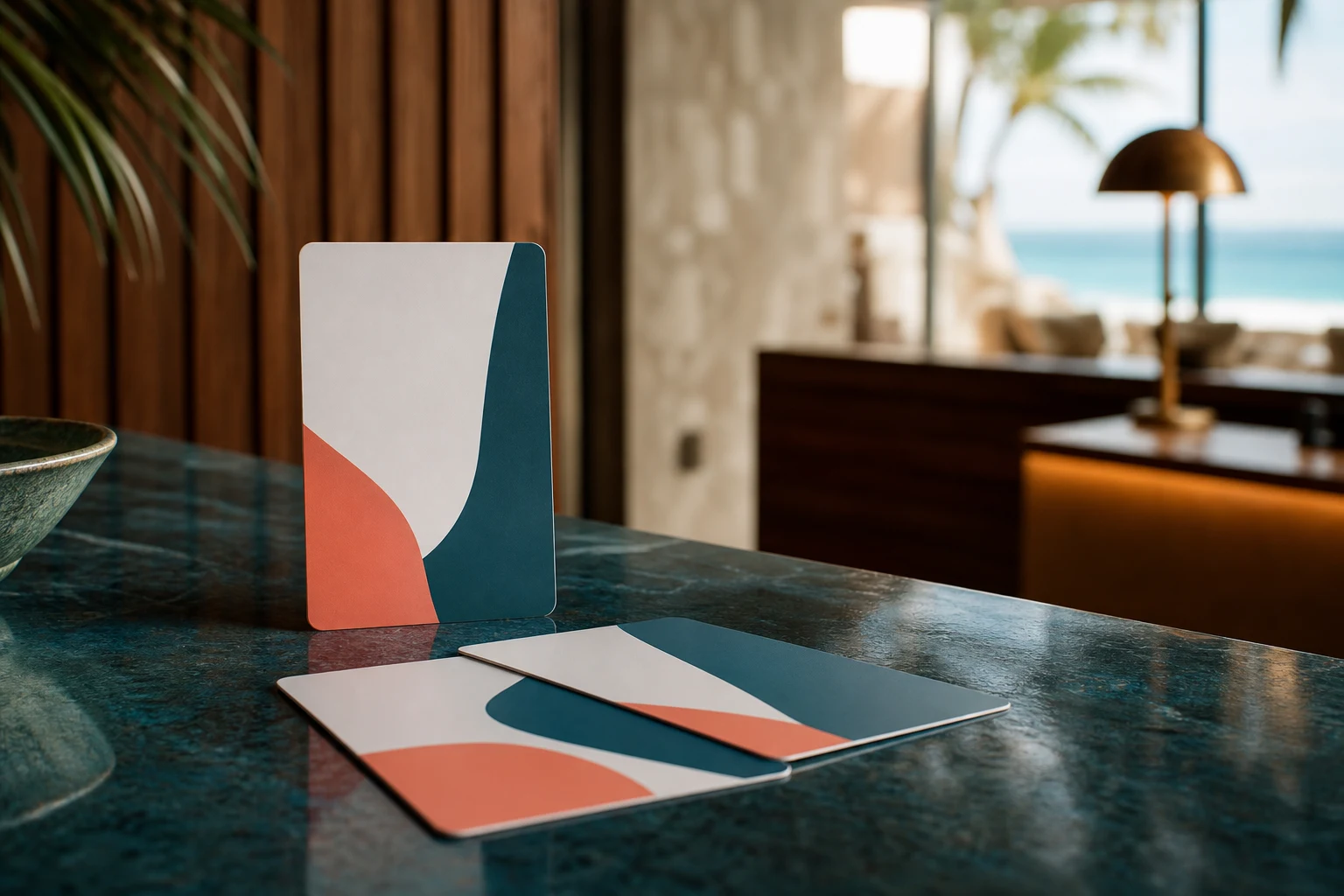
Arrival context / matte print, rounded corners and the familiar card format
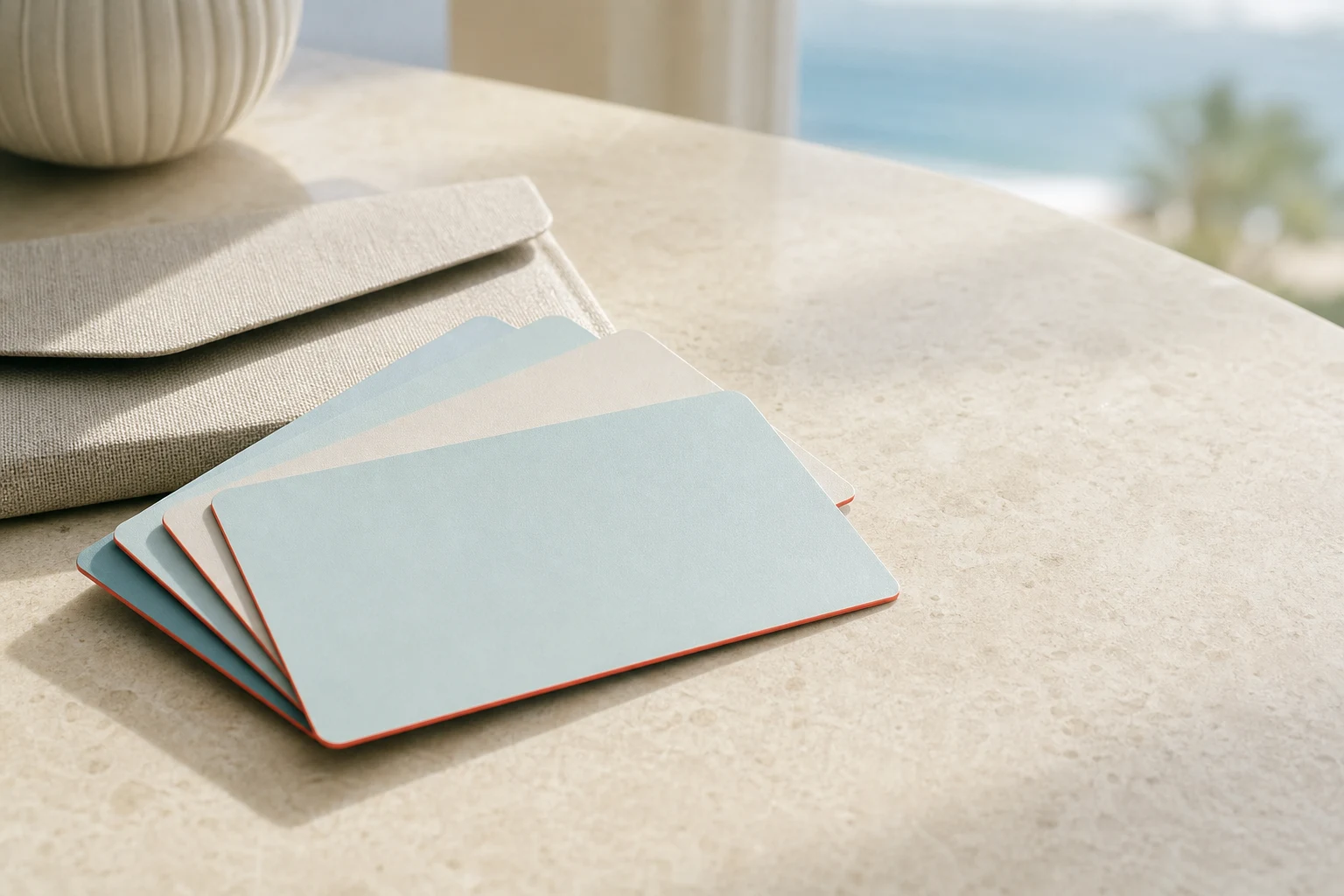
Material detail / surface, edge consistency and finished-card thickness
Specification
Four decisions before artwork.
The visible design is approved only after the functional brief is understood.
- 01
Card body and surface finish
Record the exact proposed construction and supplied documentation.
- 02
Credential and encoding requirement
Define the guest-facing finish without obscuring production limits.
- 03
Artwork and variable data
Confirm how the product will be issued, used and replaced.
- 04
Front-desk issue and reorder record
Keep the agreed requirement in the production and reorder record.
Indicative production parameters
- Card format
- CR80, 85.6 × 54 mm
- Card body
- 0.76 mm
- Credential frequency
- 13.56 MHz (ISO/IEC 14443) or 125 kHz (LF), confirmed against the installed system
- Minimum order
- 500 pieces
- Production
- 14–21 days after artwork approval
These are planning figures for a standard run. The exact construction, credential and schedule are confirmed for the property and installed system before quotation.
Manufacturer detail
How the product is specified and released.
Physical construction, artwork and credential decisions stay connected throughout production.
Control the card body
A classic hotel key card starts with the familiar CR80 format: 85.6 × 54 mm with a nominal 0.76 mm thickness. We still approve the finished body for flatness, edge condition, surface friction and movement through the intended front-desk equipment. A nominal dimension alone does not describe how a printed, finished card will feed or stack.
The body specification records material, colour, opacity, finish and any protective layer. Gloss, matte and textured surfaces change the way solid colours, photographs and small type reproduce. They can also change handling. The production sample therefore combines the selected body and finish instead of asking the property to approve a generic blank card.
Make artwork production-ready
We prepare artwork around trim, corner radius, safe areas and the visible effect of the selected surface. Fine text, reversed elements, large solid areas and variable numbering are assessed at physical size. A screen proof confirms layout and spelling; the product proof confirms colour behaviour, registration and the appearance of edges on the manufactured object.
Cards for several buildings or guest groups can share a visual system while remaining separate designs. Logo, language, colour, numbering and access class are mapped before release so the MOQ of 500 units per design is understood. Packing labels can then preserve those distinctions for the front desk without suggesting that visual similarity establishes electronic compatibility.
Confirm the access core
The installed system determines whether the card requires 125 kHz LF or 13.56 MHz HF/NFC. We use a working credential or accountable technical record, identify the encoding owner and test a production-representative card. A photograph, an old invoice description or a successful phone detection is not sufficient evidence for a hotel access run.
Encoding at the property and supported encoding before delivery are different workflows. The brief records who supplies data, how it is verified and which identifiers, if any, appear visibly on the card. Access permissions, room assignment and cancellation remain functions of the property system; the manufactured card carries only the approved credential and data requirement.
Protect the reorder
The retained manufacturing record joins the approved body, finish, artwork revision, credential description, variable-data rules and packing sequence. A reorder should cite that record rather than a photo of the last card. This prevents a visually similar replacement from being produced with a different surface, electronic core or numbering convention.
Changes to the installed system, encoder, card finish or design trigger review before production. The property can keep a familiar guest experience while the technical record changes behind it, but those changes must be explicit. Consistency comes from a controlled specification and retained sample, not from the broad label classic key card.
Compatibility boundary
The product body does not determine the credential.
Frequency, memory, encoding and system rules are confirmed separately. If compatibility cannot be established, the order should not proceed as an access credential.
See the compatibility process ↗Wrong fit
When classic hotel key cards are the wrong direction.
Classic cards are the wrong direction where guests spend most of the stay in wet zones and repeatedly lose or damage a carried credential, or where the property needs a visibly non-transferable wearable. They are also wrong when the hotel expects the familiar shape to guarantee compatibility. If the working credential, encoder workflow or finished-card handling cannot be confirmed, the order should not proceed as an access card.
Confirm the product ↗Build the brief
Confirm the product and credential together.
Share the property, destination, product direction and any system information already available. The secure form sends the brief directly to our manufacturing team, with the product, quantity and system notes kept together for review.
Plan the order ↗