Arrival
A familiar card or wearable handover supported by a clear issue process.
Use case / Resorts
Resort access is rarely a single-door decision. We map how guests move, where water exposure begins and whether cards, wristbands or a coordinated combination provide the clearest experience.
Room-to-water continuity
Multiple guest and staff formats
Destination-aware replenishment planning
Operational fit
Product, credential and delivery decisions follow the use case—not the other way around.
A familiar card or wearable handover supported by a clear issue process.
Material and wear period selected around pools, spas and active use.
Different product formats documented against their intended access zones.
Manufacturer detail
These are production controls, not assumed functions of a property's access system.
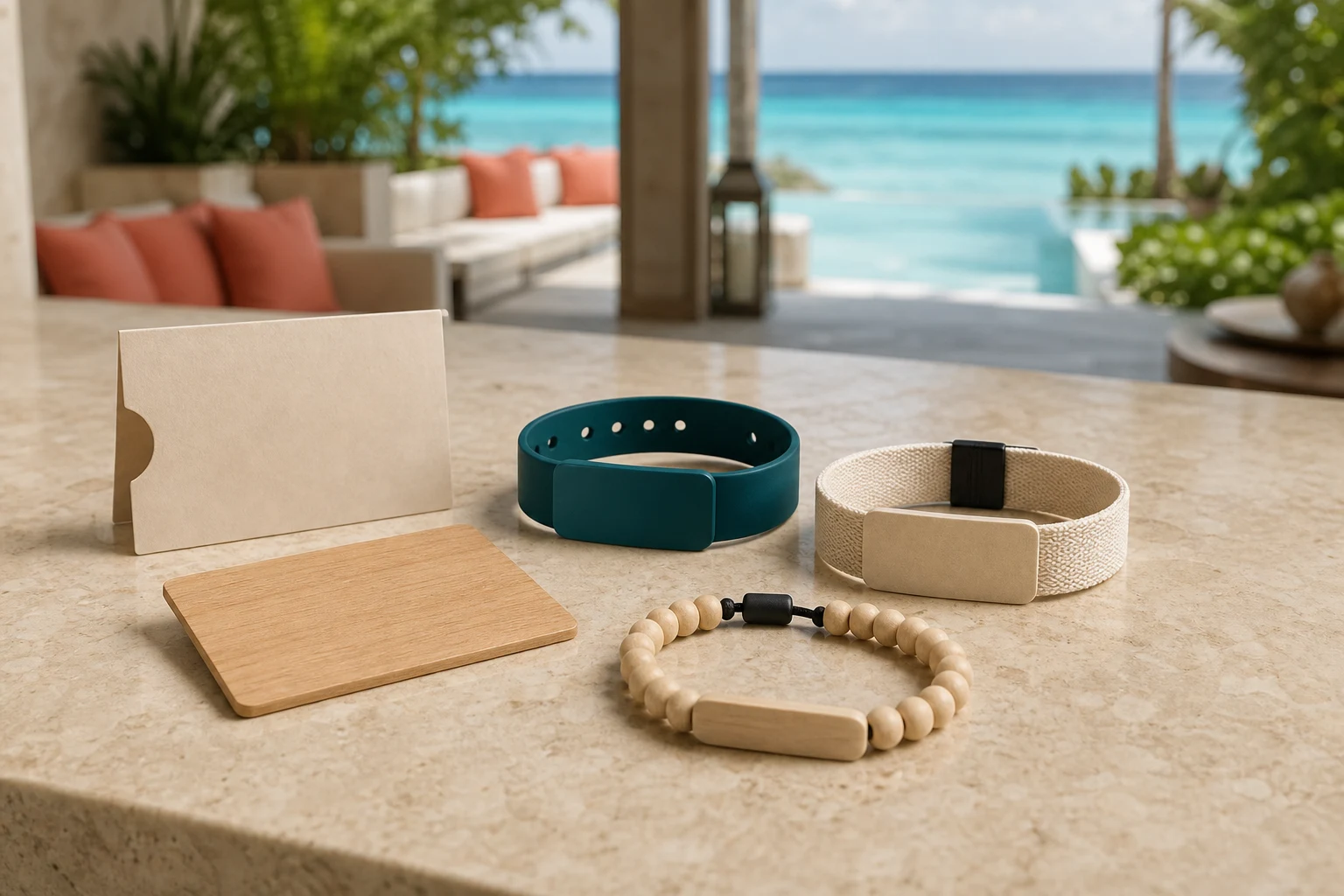
A resort stay rarely runs on a single credential. The room may take a card, the pool and beach service may take a wristband, and staff and contractor areas may take a third variant. These are separate manufactured products that happen to serve one guest journey, and the specification has to hold them together: which format covers which zone, which are issued at check-in, and which are replaced during the stay.
We write the estate as a list of products with their intended access zones attached, so the approval covers the whole set rather than each item in isolation. That matters at reorder, when consumption rates differ sharply between formats. Room cards may last a season while single-stay wristbands turn over weekly, and a combined order that ignores the difference either overstocks one line or runs the other short.
Anything issued for pool, beach or spa use is a construction question before it is a material preference. The relevant inputs are how long the product is worn, whether it is submerged or splashed, whether it is removed to shower, and what it is exposed to besides water: sunscreen, chlorine, salt and abrasion against furniture and sand. Those answers narrow the body, the closure and the way the inlay is sealed.
We select from constructions we can actually produce and document for the exposure described, and we state the wear period the sample was built for. What we do not do is publish a durability figure that the property cannot verify. Where the exposure is unusual or the wear period is longer than the format is designed for, that is said before the order rather than discovered in the second week.
Large properties want staff, guests, day visitors and contractors to be distinguishable at a glance. The instinct is a separate design for each, which turns one order into five production items each carrying its own minimum. Colour, printed band, deboss position or a numbering block will usually carry the same separation on a shared body, and cost far less in both stock and approval time.
The specification records which differentiator is doing the work and whether it is visual, encoded or both. That distinction matters operationally: a printed colour tells a member of staff something, but it does not tell a reader anything. Where the property needs the system to enforce a difference rather than a person to observe it, that requirement belongs with the system owner and is confirmed separately.
Resort estates are physically spread out, and the receiving point is rarely where the credential is finally issued. A single mixed carton of visually similar products creates avoidable errors at the desk. We can pack by product, design and numbering range in labelled lots tied to the approved artwork, so a discrepancy is traceable to a specific range and carton rather than to the order as a whole.
The order record identifies the receiving point and the lot structure. It does not promise transit time or customs treatment, which are planned separately and on their own timeline. Once stock is received, internal movement between buildings is the property's process; what the manufacturing record guarantees is that the lots arrived labelled in a way that survives that movement.
Build the brief
Share the property, destination, product direction and any system information already available. The secure form sends the brief directly to our manufacturing team, with the product, quantity and system notes kept together for review.
Plan the order ↗