Product / Contact cards
A tap-to-open contact format—not a hotel room credential.
NFC contact cards can open an approved digital destination such as a contact profile or property page. They are specified as communication tools and must not be presented as interchangeable with room-access credentials.
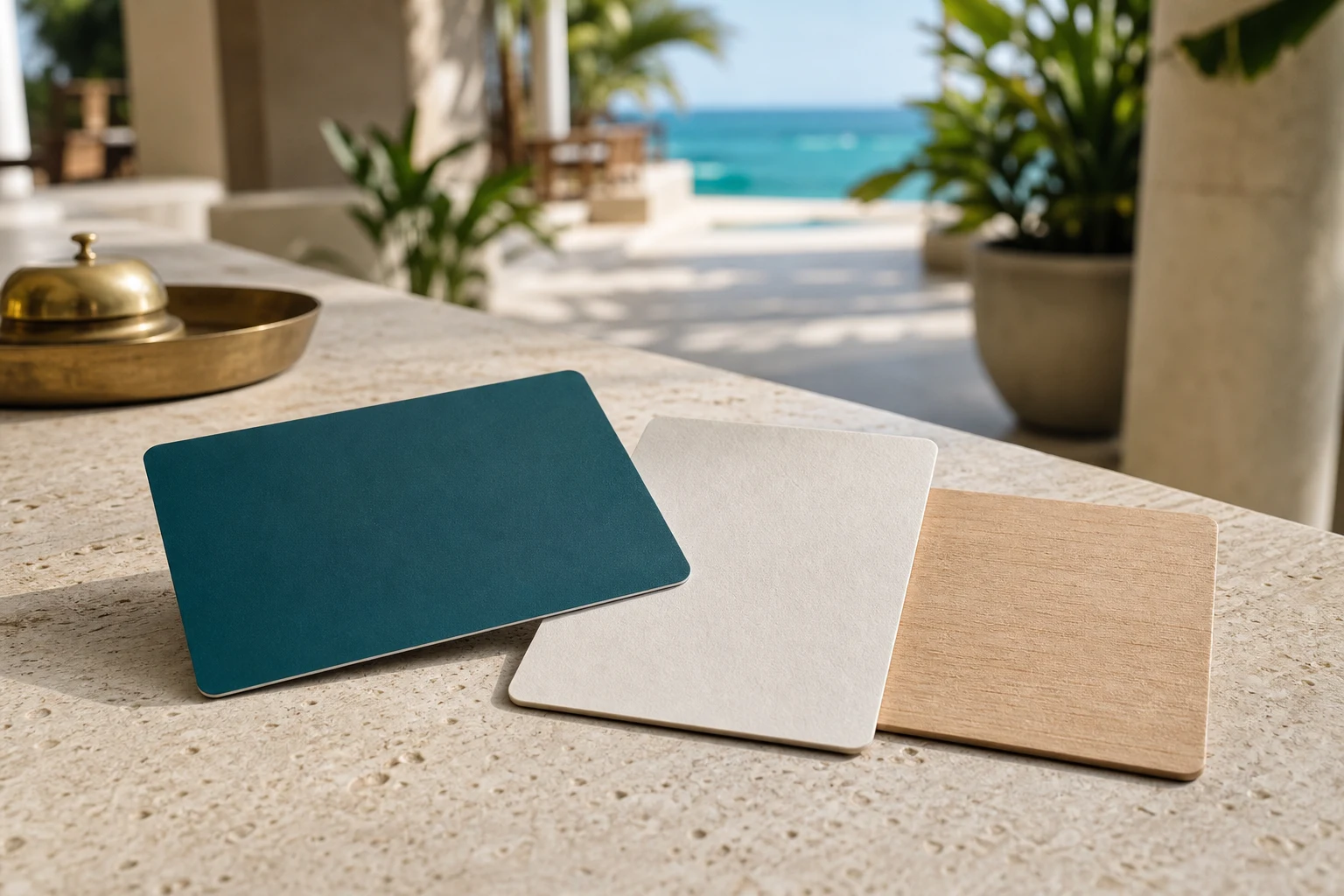
Approved destination URL
Card material and print
Update and ownership process
Original product studies
Context at scale.
Construction up close.
Each image is an original illustrative product study created for this range. The approved production sample remains the controlling reference.
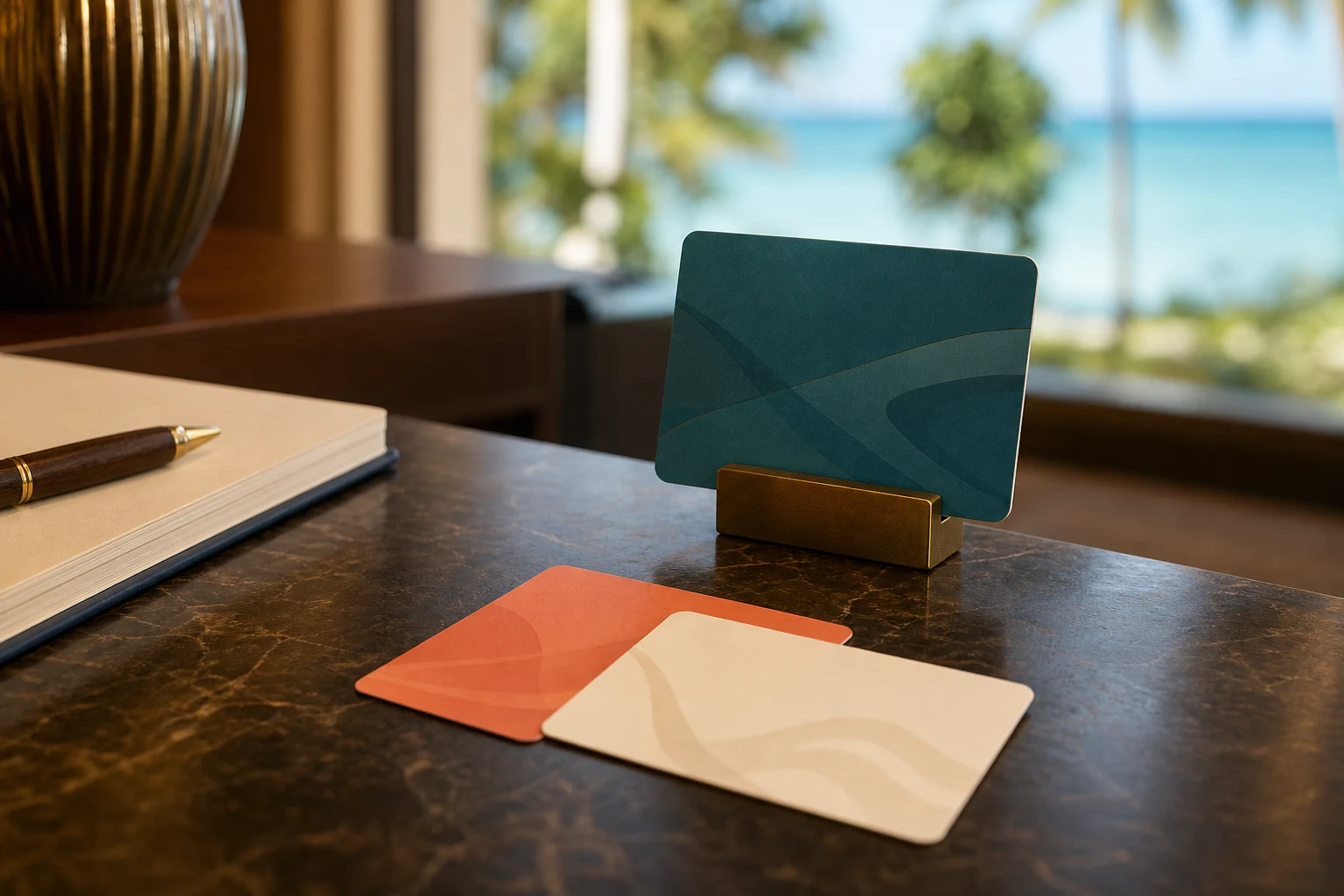
Concierge context / communication cards kept visibly separate from room keys
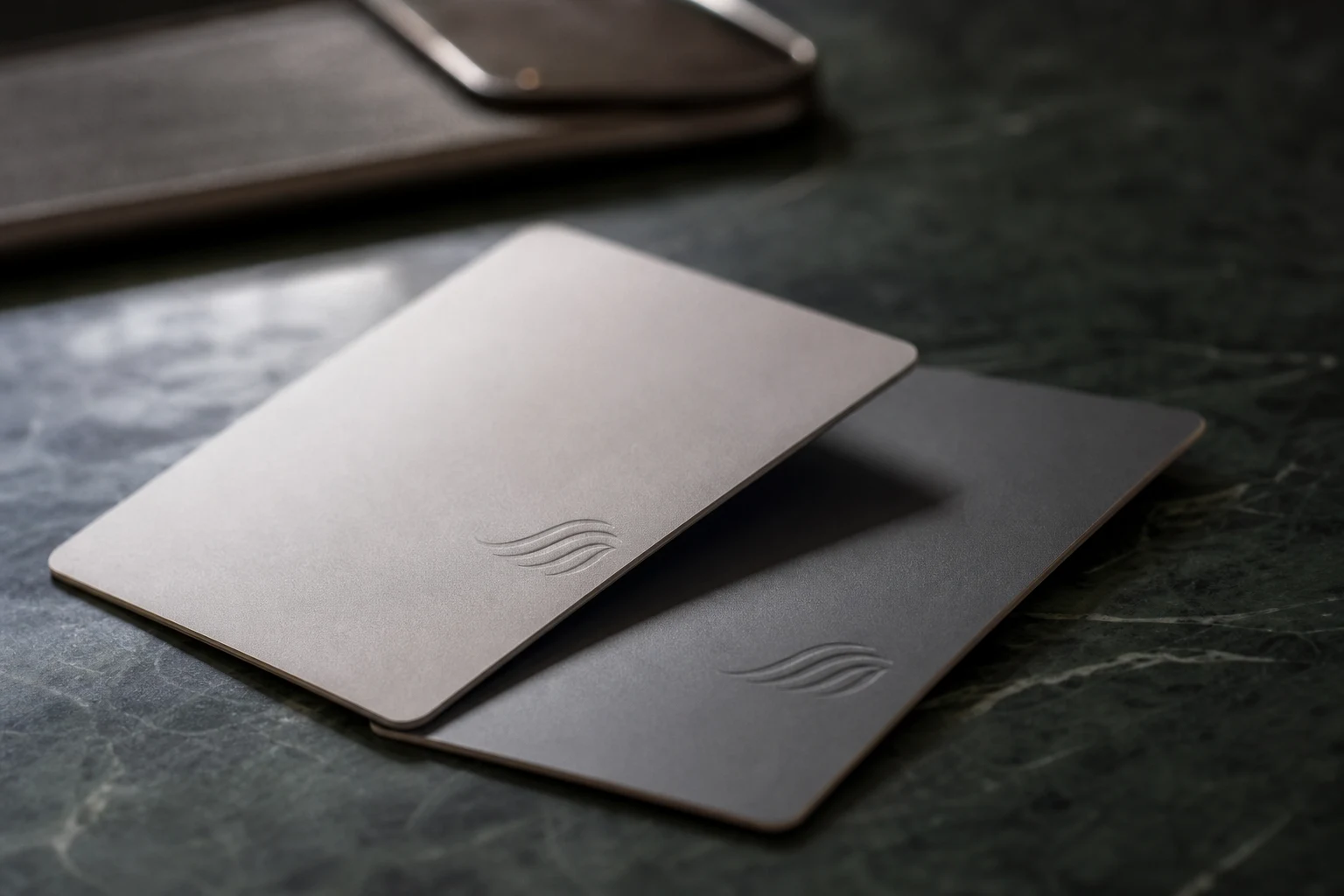
Surface detail / matte print, rounded edges and consistent card construction
Specification
Four decisions before artwork.
The visible design is approved only after the functional brief is understood.
- 01
Approved destination URL
Record the exact proposed construction and supplied documentation.
- 02
Card material and print
Define the guest-facing finish without obscuring production limits.
- 03
Update and ownership process
Confirm how the product will be issued, used and replaced.
- 04
Clear separation from access cards
Keep the agreed requirement in the production and reorder record.
Indicative production parameters
- Card format
- CR80, 85.6 × 54 mm
- Card body
- 0.76 mm
- Credential frequency
- 13.56 MHz (ISO/IEC 14443)
- Minimum order
- 500 pieces
- Production
- 14–21 days after artwork approval
These are planning figures for a standard run. The exact construction, credential and schedule are confirmed for the property and installed system before quotation.
Manufacturer detail
How the product is specified and released.
Physical construction, artwork and credential decisions stay connected throughout production.
Define the tap destination
An NFC contact card is manufactured around a specific approved digital destination, such as a contact profile or property information page. The owner, URL, redirect behaviour and update process are confirmed before encoding. A vague instruction to open our website does not provide enough control for proofing and later verification.
The destination should be tested on the intended phone journey, but the card does not operate or host that page. Website availability, consent and content governance remain with the destination owner. We record the supported encoded value and distinguish it clearly from hotel room-access data.
Select body and finish
The card follows the CR80 format of 85.6 × 54 mm with a nominal 0.76 mm thickness unless another approved construction is specified. Body, print, coating and edge quality are reviewed as a finished object. Surface decisions should support repeated handover without implying performance that the sample has not demonstrated.
Artwork can carry contact details, a call to action or instructions, but the tap area and printed destination must not contradict the encoded record. Small text, QR codes where included and fine marks are checked at physical size. The digital proof controls content; the sample controls print and handling.
Keep contact and access roles apart
These cards use a supported 13.56 MHz HF/NFC interaction for an approved contact destination. They are not described as hotel room credentials and should not be designed so guests or staff confuse them with access cards. Distinct artwork, issue location and written purpose help preserve that operational boundary.
A phone successfully opening the destination proves only the intended contact interaction. It does not demonstrate compatibility with door readers, payment services or property access systems. Any separate access product requires its own working credential, encoding record and production-representative test.
Control data and reorders
The production record combines the approved body, artwork, encoded destination, visible numbering if used and packing. Production begins from an MOQ of 500 units per design. A verification sample is checked against the final destination before the full run is released.
On reorder, we confirm that the destination remains owned and active and that no card-body or artwork change affects the approval. If the property wants a new link, language or team identity, that change becomes a new revision. This prevents an outdated encoded destination from being reproduced behind current-looking artwork.
Compatibility boundary
The product body does not determine the credential.
Frequency, memory, encoding and system rules are confirmed separately. If compatibility cannot be established, the order should not proceed as an access credential.
See the compatibility process ↗Wrong fit
When nfc contact cards are the wrong direction.
NFC contact cards are the wrong direction when the hotel needs a room-access credential, when the destination owner cannot maintain the linked page, or when staff cannot distinguish the card from operational keys. They are also wrong if a printed promise suggests payment, access or data collection that the destination and systems do not support. The product should remain a clearly defined communication tool.
Confirm the product ↗Build the brief
Confirm the product and credential together.
Share the property, destination, product direction and any system information already available. The secure form sends the brief directly to our manufacturing team, with the product, quantity and system notes kept together for review.
Plan the order ↗