Product / Key cards
An alternative card body that requires precise material and claim review.
Plant-based card bodies can change the material story without changing the need for technical accuracy. Composition, disposal language and environmental claims are reviewed against documentation for the specific product supplied.
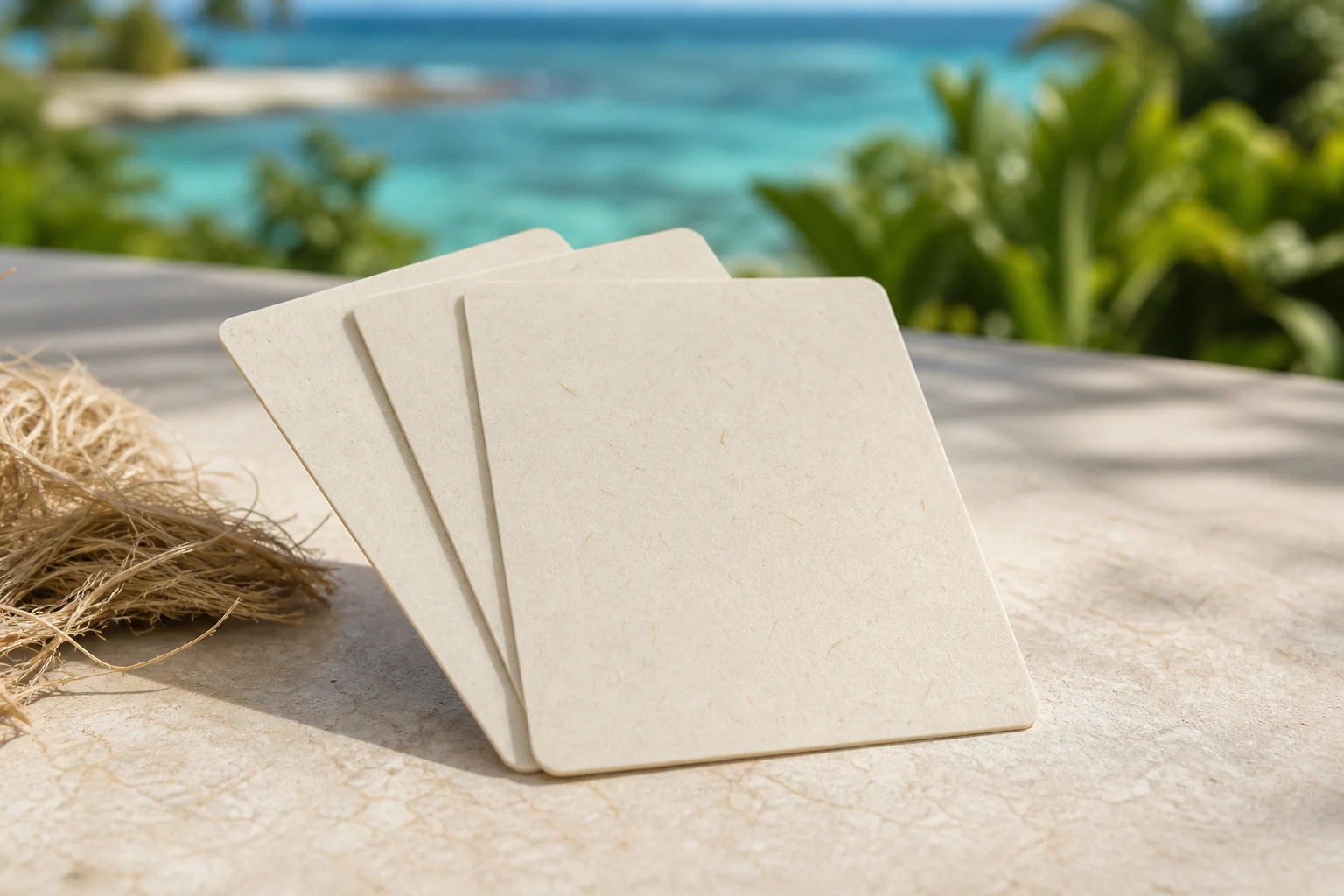
Exact material composition
Approved environmental wording
Print and finishing compatibility
Original product studies
Context at scale.
Construction up close.
Each image is an original illustrative product study created for this range. The approved production sample remains the controlling reference.
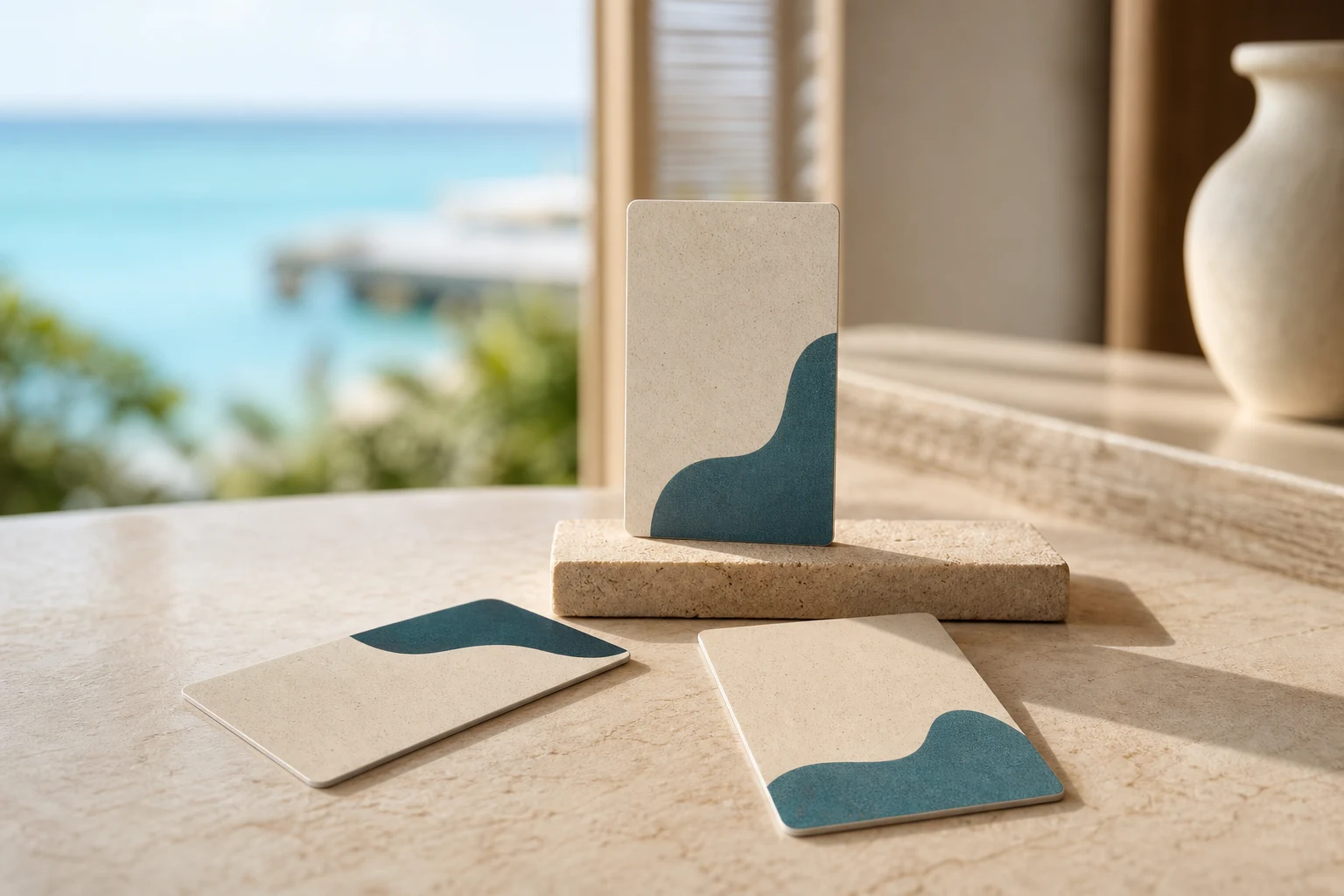
Hospitality context / warm body texture with no disposal claim implied
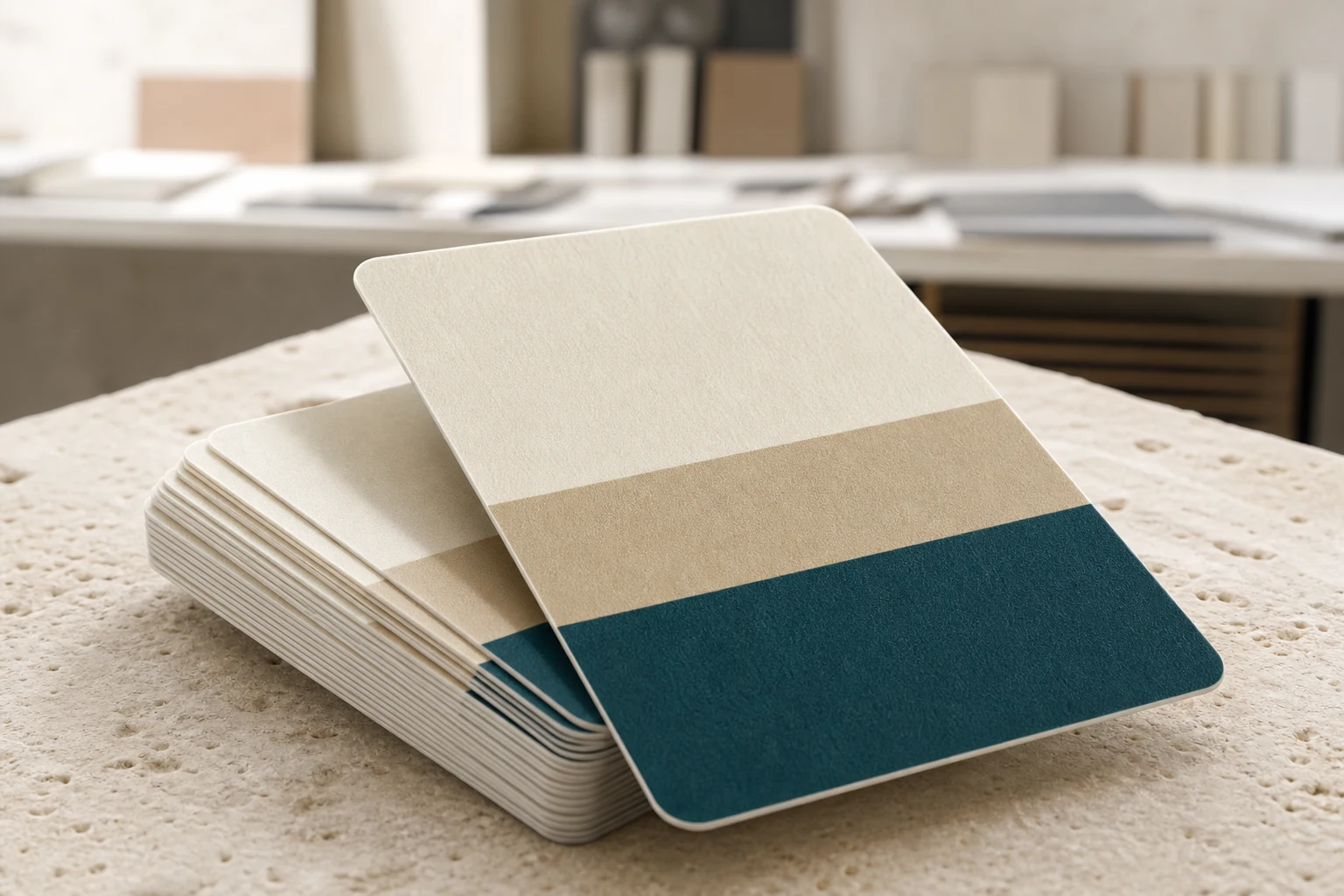
Material detail / surface response, print finish and edge consistency
Specification
Four decisions before artwork.
The visible design is approved only after the functional brief is understood.
- 01
Exact material composition
Record the exact proposed construction and supplied documentation.
- 02
Approved environmental wording
Define the guest-facing finish without obscuring production limits.
- 03
Print and finishing compatibility
Confirm how the product will be issued, used and replaced.
- 04
Credential and encoding requirement
Keep the agreed requirement in the production and reorder record.
Indicative production parameters
- Card format
- CR80, 85.6 × 54 mm
- Card body
- 0.76 mm
- Credential frequency
- 13.56 MHz (ISO/IEC 14443) or 125 kHz (LF), confirmed against the installed system
- Minimum order
- 500 pieces
- Production
- 14–21 days after artwork approval
These are planning figures for a standard run. The exact construction, credential and schedule are confirmed for the property and installed system before quotation.
Manufacturer detail
How the product is specified and released.
Physical construction, artwork and credential decisions stay connected throughout production.
Name the body accurately
Plant-based is a category description, not a complete specification. The order record names the exact supplied body, the component to which the description applies and the evidence available for that run. Coatings, print, adhesive and the RFID inlay remain visible in the discussion rather than disappearing behind a broad material headline.
A plant-derived input does not automatically prove biodegradation, compostability, recyclability or acceptance by a local waste stream. We keep those outcomes out of the artwork unless evidence and operating reality support them. Precise component wording is more defensible and more useful than an environmental phrase that overstates the completed electronic card.
Prove format and print
The standard planning format is CR80 at 85.6 × 54 mm with a nominal 0.76 mm thickness. The selected body must still be reviewed for flatness, edge quality, surface friction and feed. Alternative materials can respond differently to ink coverage and finishing, so nominal dimensions do not replace a physical sample.
We proof the approved artwork on the proposed body and review registration, colour, fine text, abrasion and edge appearance. Natural or batch variation is described where relevant. The digital proof settles content and position; the physical proof demonstrates what the manufactured surface can reproduce consistently enough for the hotel’s brand requirement.
Approve access on its own evidence
The body cannot reveal whether the installed system requires 125 kHz LF or 13.56 MHz HF/NFC. That requirement comes from a working credential or accountable system record. We identify encoding responsibility and test a production-representative card through the reader and normal front-desk handling sequence.
Material approval and credential approval remain separate gates. A hotel may accept the look of a blank sample while technical verification continues, but the blank cannot be described as a functioning room key. Likewise, a compatible inlay does not approve print, finish or the material claim on the finished product.
Carry evidence into repeat runs
The released file contains body description, supporting document, claim text, artwork, credential, data rules and packing. Production begins from an MOQ of 500 units per design. If different properties or languages use different material wording, those variations are counted and approved independently before manufacture.
On reorder, we confirm that the same construction and evidence remain current. A change of source, protective layer or finish can affect both claim accuracy and handling. The older artwork is not copied automatically; it returns to review so the next run still matches what the property communicates to guests.
Compatibility boundary
The product body does not determine the credential.
Frequency, memory, encoding and system rules are confirmed separately. If compatibility cannot be established, the order should not proceed as an access credential.
See the compatibility process ↗Wrong fit
When plant-based cards are the wrong direction.
Plant-based cards are the wrong direction when the resort requires a disposal or biodegradation claim that the exact construction cannot support, or when the sample performs poorly in wet, abrasive or repeated-use handling. They are also wrong when feed through the installed encoder is inconsistent. The preferred material story must yield to an honest claim and a reliable front-desk product.
Confirm the product ↗Build the brief
Confirm the product and credential together.
Share the property, destination, product direction and any system information already available. The secure form sends the brief directly to our manufacturing team, with the product, quantity and system notes kept together for review.
Plan the order ↗