Product / Key cards
Natural material presence, with the credential specification handled first.
Wood key cards bring a tactile, hospitality-led surface to the check-in moment. Wood species, construction, print method and environmental claims must be documented for the approved order.
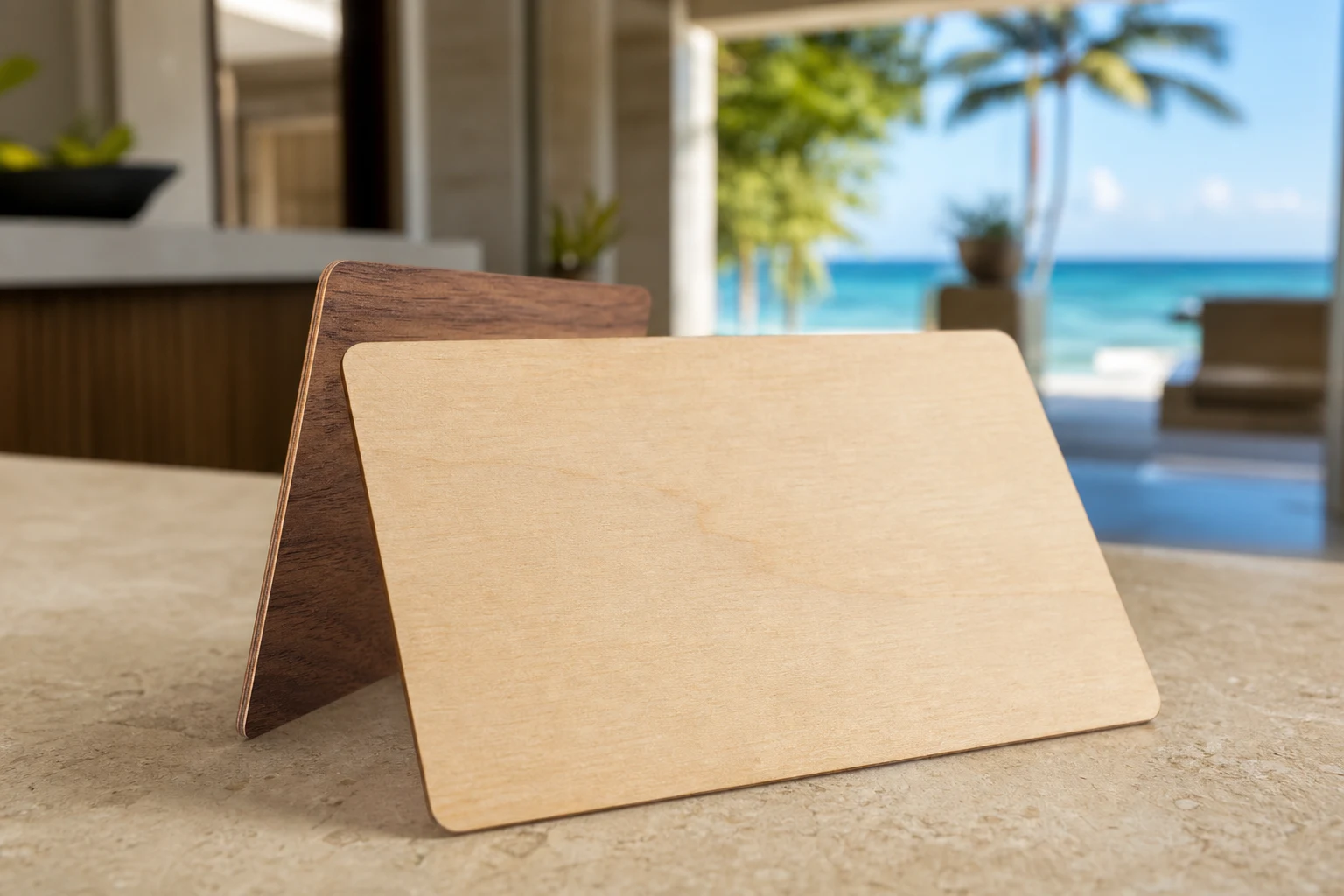
Wood construction and finish
Print, laser or combined artwork
Credential and encoding requirement
Original product studies
Context at scale.
Construction up close.
Each image is an original illustrative product study created for this range. The approved production sample remains the controlling reference.
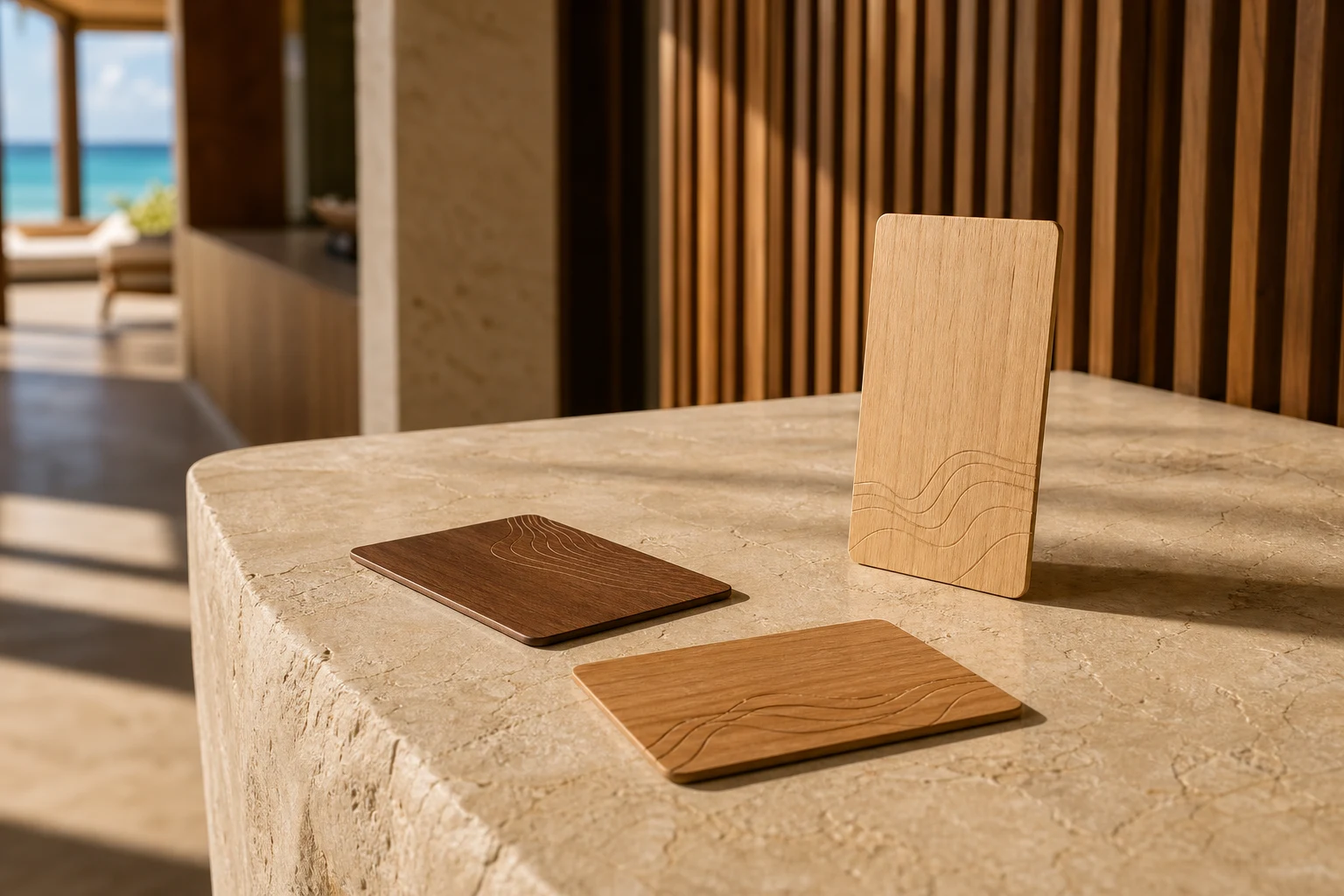
Hospitality context / natural grain and restrained engraved artwork
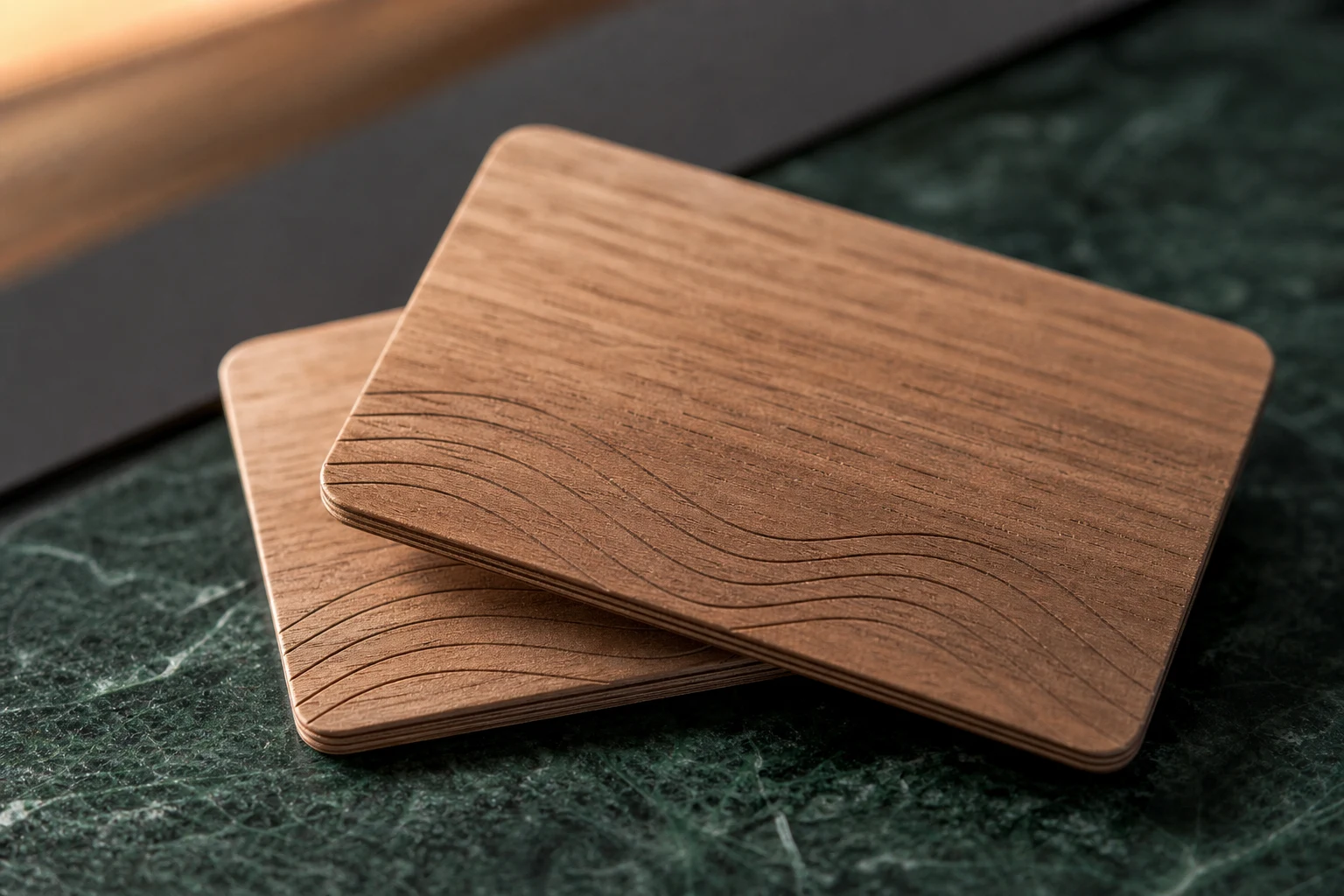
Construction detail / veneer grain, layered edges and rounded corners
Specification
Four decisions before artwork.
The visible design is approved only after the functional brief is understood.
- 01
Wood construction and finish
Record the exact proposed construction and supplied documentation.
- 02
Print, laser or combined artwork
Define the guest-facing finish without obscuring production limits.
- 03
Credential and encoding requirement
Confirm how the product will be issued, used and replaced.
- 04
Packaging and humidity exposure
Keep the agreed requirement in the production and reorder record.
Indicative production parameters
- Card format
- CR80, 85.6 × 54 mm
- Credential frequency
- 13.56 MHz (ISO/IEC 14443) or 125 kHz (LF), confirmed against the installed system
- Minimum order
- 500 pieces
- Production
- 14–21 days after artwork approval
These are planning figures for a standard run. The exact construction, credential and schedule are confirmed for the property and installed system before quotation.
Manufacturer detail
How the product is specified and released.
Physical construction, artwork and credential decisions stay connected throughout production.
Specify the layered object
A wood RFID card is more than a species name. We document veneer or body construction, core, adhesive, edge treatment, surface finish and the embedded RFID assembly. These parts determine flatness, strength and handling together. The property approves a completed sample rather than a loose wood swatch beside an unrelated credential.
Natural grain and tone vary from card to card. A representative sample set establishes an acceptable appearance range, including edges and grain direction. That range should support the design instead of being treated as a defect after production. Exact visual uniformity is not a credible requirement for a naturally variable surface.
Design for print or engraving
Print can carry colour and detailed branding, while engraving creates a tactile mark whose contrast follows the surface. Fine reversed type, large solids and subtle gradients need physical review. We test the actual artwork at final size and decide whether print, engraving or a controlled combination produces a legible result across representative grain.
The digital proof controls position, wording and scale; it does not predict every natural mark. The product proof adds finish, edge clearance, variable numbering and the effect of the selected decoration. If exact corporate colour is essential, the property should assess whether a wood surface can meet that expectation before approval.
Test equipment and credential together
The planning format remains CR80 at 85.6 × 54 mm with a nominal 0.76 mm thickness. The final layered construction is still checked for flatness, edge condition, stacking and encoder movement. A card that reads when held to a reader may remain unsuitable if it catches or feeds inconsistently at reception.
The installed system confirms 125 kHz LF or 13.56 MHz HF/NFC and any supported encoding. We test the credential inside the proposed wood build rather than carrying approval over from a conventional card. The property system remains responsible for permissions, issue and cancellation; our record controls the manufactured physical credential.
Plan storage and repeat appearance
Wood responds to environmental conditions, making storage and packing part of the production brief. The physical trial should include realistic handling and the property’s stock environment. Inner protection, carton arrangement and stock rotation can be specified where appropriate to preserve the approved condition before cards reach the front desk.
For reorders, we retain construction, finish, artwork, credential, packing and the accepted range of natural variation. A later run cannot duplicate grain piece for piece, but it should remain within the approved product language. A change of construction or finish requires a new sample instead of relying on the old screen proof.
Compatibility boundary
The product body does not determine the credential.
Frequency, memory, encoding and system rules are confirmed separately. If compatibility cannot be established, the order should not proceed as an access credential.
See the compatibility process ↗Wrong fit
When wood key cards are the wrong direction.
Wood cards are the wrong direction for rough, wet or high-turnover handling when the sample does not retain acceptable flatness, edges and appearance. They are also wrong where every card must reproduce an identical colour or grain. Most importantly, a natural surface must not be allowed to distract from equipment and credential approval; the final layered card must pass both checks.
Confirm the product ↗Build the brief
Confirm the product and credential together.
Share the property, destination, product direction and any system information already available. The secure form sends the brief directly to our manufacturing team, with the product, quantity and system notes kept together for review.
Plan the order ↗