Locker access
Credential technology matched to the installed locker or access system.
Use case / Spa & wellness
Spa and wellness access benefits from low-profile formats, comfortable materials and restrained artwork. Locker compatibility, humidity and expected wear time must be confirmed before product selection.
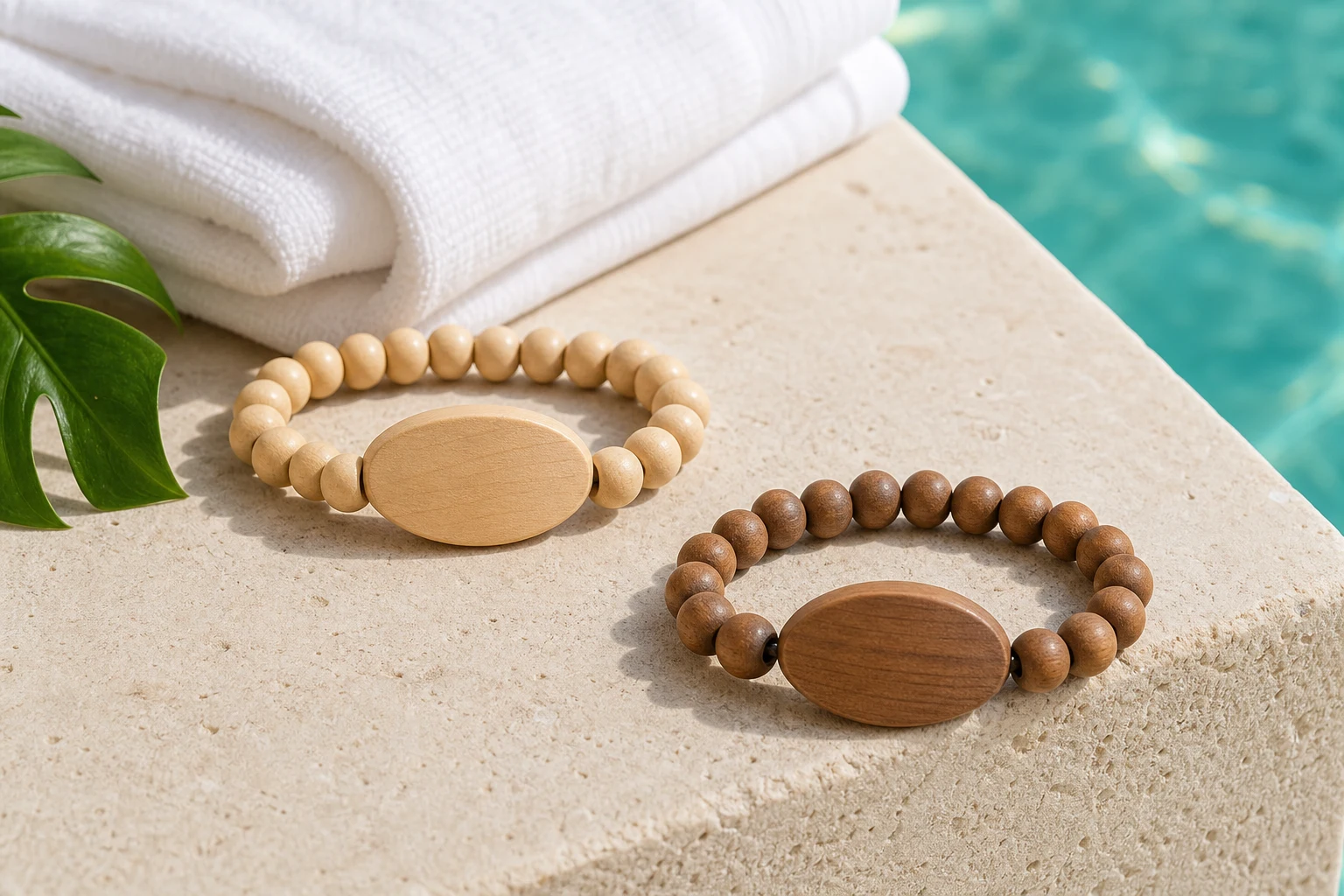
Low-profile guest wear
Humidity and water consideration
Restrained material and artwork
Operational fit
Product, credential and delivery decisions follow the use case—not the other way around.
Credential technology matched to the installed locker or access system.
Comfort and issue method considered alongside access function.
Natural materials and quiet artwork selected without overstating claims.
Manufacturer detail
These are production controls, not assumed functions of a property's access system.
Spa and wellness environments work against visible hardware. The credential is often worn against skin during treatment, placed in a locker, or handed over in a setting where a bright printed band would be out of place. That pushes the design toward thinner bodies, narrower bands, quieter surfaces and, in some cases, a small carried token rather than a worn credential.
Each of those choices constrains where the electronics can sit. A narrower or thinner body reduces the available area, which affects the module position and how the credential should be presented at a reader. We record the intended presentation face and any instruction staff need to give guests, and we confirm the construction on a sample rather than assuming a smaller body behaves like a full-size one.
The relevant exposure in a spa is not submersion. It is sustained humidity, steam, massage and treatment oils, and cleaning products used on lockers and surfaces. Those attack print and adhesives differently from pool water, and a construction chosen for a beach environment is not automatically correct here.
We ask which products the credential will actually meet and for how long, then select a construction and print method against that list. Where a treatment product is unusual or aggressive, the honest position is to test a sample in the property's environment before committing a run. A finish that survives chlorine can still lift under a particular massage oil, and that is cheaper to discover on one sample.
Wellness properties often want natural materials and quiet finishes, which we can manufacture. What we do not do is attach language to those materials that the documentation for the exact supplied product does not carry. Descriptions of origin, content or end-of-life handling are limited to what the supplier evidence states for the batch actually produced.
That restraint is a practical protection as much as a legal one. A property publishing a material claim it cannot evidence carries that exposure itself, and a spa brand is more likely than most to have it read closely. We supply what the documentation supports and record it in the release, so the property knows exactly what it can and cannot say about the object it is handing to a guest.
A spa or wellness area usually needs a fraction of the credential volume a hotel does — often a single locker population and a small staff set. At those quantities the production minimum, not the unit price, is the number that governs. A design split into three variants for a forty-locker area produces stock that will not be consumed for years.
The workable answer is usually one design carrying variable data, or a shared body with the wider property that differs only in a printed field. We say when a requested split will produce dead stock, because at this scale the difference between a sensible specification and an over-specified one is most of the order value.
Build the brief
Share the property, destination, product direction and any system information already available. The secure form sends the brief directly to our manufacturing team, with the product, quantity and system notes kept together for review.
Plan the order ↗