Day entry
Simple issue and collection rules for short-duration access.
Use case / Beach clubs
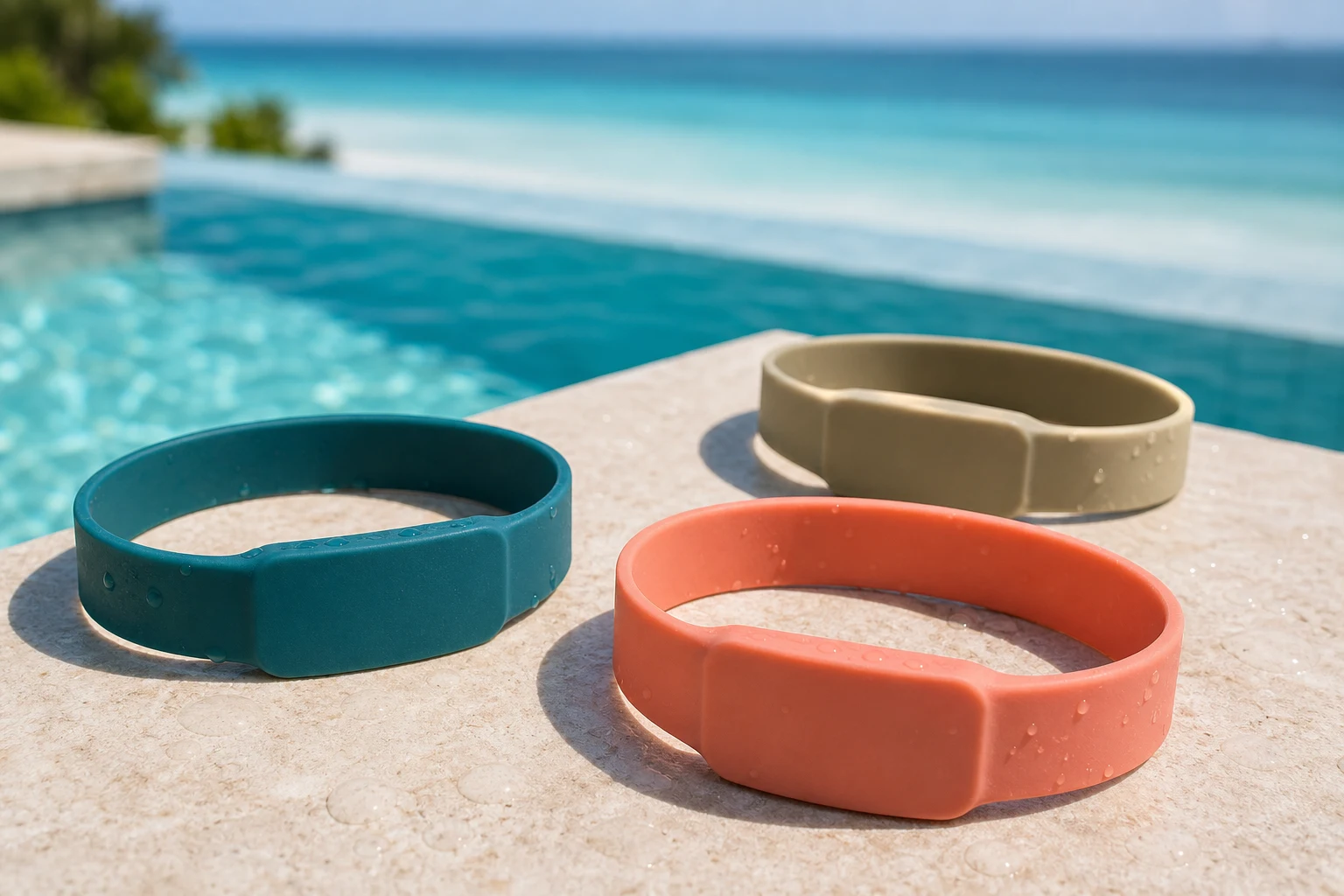
Beach clubs need credentials that can be issued quickly, remain comfortable and support the access functions already available in the property system. Wear period and water exposure lead the product decision.
Fast day-guest issue
Water and sunscreen exposure
Visible guest-group differentiation
Operational fit
Product, credential and delivery decisions follow the use case—not the other way around.
Simple issue and collection rules for short-duration access.
Material chosen for the expected exposure and wear period.
Additional functions considered only where the installed system supports them.
Manufacturer detail
These are production controls, not assumed functions of a property's access system.
A beach club credential is defined by how long it stays on a guest. A few hours of day access, a full day with repeated water entry and a returning-member credential held for a season are three different products. The short-duration item can be built for comfort and quick issue at a low cost per piece; the returning-member credential has to survive repeated exposure and is priced accordingly.
Getting this wrong is expensive in both directions. A durable construction issued for four hours and discarded wastes most of what was paid for it. A light construction issued for a season fails in service, and the replacement cost plus desk time exceeds what the correct product would have cost at the outset. We ask for the wear period first because it moves the price more than almost any other input.
Water alone is the easiest part of a beach environment. The harder exposures are sunscreen and oils, which attack some surfaces and lift some print; salt, which dries into closures and printed areas; and abrasion against sand, loungers and boat fittings. A construction that handles submersion cleanly can still lose its printed face to sunscreen within a day.
So the exposure list drives the construction and the print method together. Where a printed face has to survive oils and abrasion, that may push the design toward a deboss, a woven detail or an under-laminate treatment rather than a surface print. We produce a representative sample for the property to handle in its actual environment, because a sample that looks correct in a proof does not answer the sunscreen question.
A reusable credential is collected, cleaned and reissued; a single-stay credential is issued once and disposed of. That single decision changes the construction, the closure, the numbering strategy and the volume. Reusable stock is sized to peak concurrent guests plus a loss allowance. Single-stay stock is sized to total admissions across the period, which is a much larger number.
Reusable formats also need a collection process to work at all, and that process is the property's rather than the manufacturer's. Where collection is unreliable, a reusable credential quietly becomes a single-use one at a reusable price. We ask about collection before recommending a direction, because the honest answer sometimes points to a cheaper construction ordered in higher volume.
Day-guest issue is a throughput problem at a desk with a queue. Credentials that arrive in unlabelled bulk have to be counted and sorted before service, usually at the least convenient moment. We can pack in counted lots by design and range so a desk opens a known quantity and can reconcile against it at close.
The count also supports the collection process. If a shift opens a labelled lot and returns a counted remainder, shrinkage is visible daily instead of at the end of the season. None of this requires special construction; it requires the packing structure to be decided during the order rather than assumed afterwards.
Build the brief
Share the property, destination, product direction and any system information already available. The secure form sends the brief directly to our manufacturing team, with the product, quantity and system notes kept together for review.
Plan the order ↗