Villa guests
A wood or bead credential intended to be kept, matched to the property's arrival experience.
Island / Turks and Caicos
Providenciales and the surrounding cays run comparatively small, high-value properties. The credential population per property is modest, which changes both the material logic and the ordering rhythm — quality per piece matters more than cost per piece.
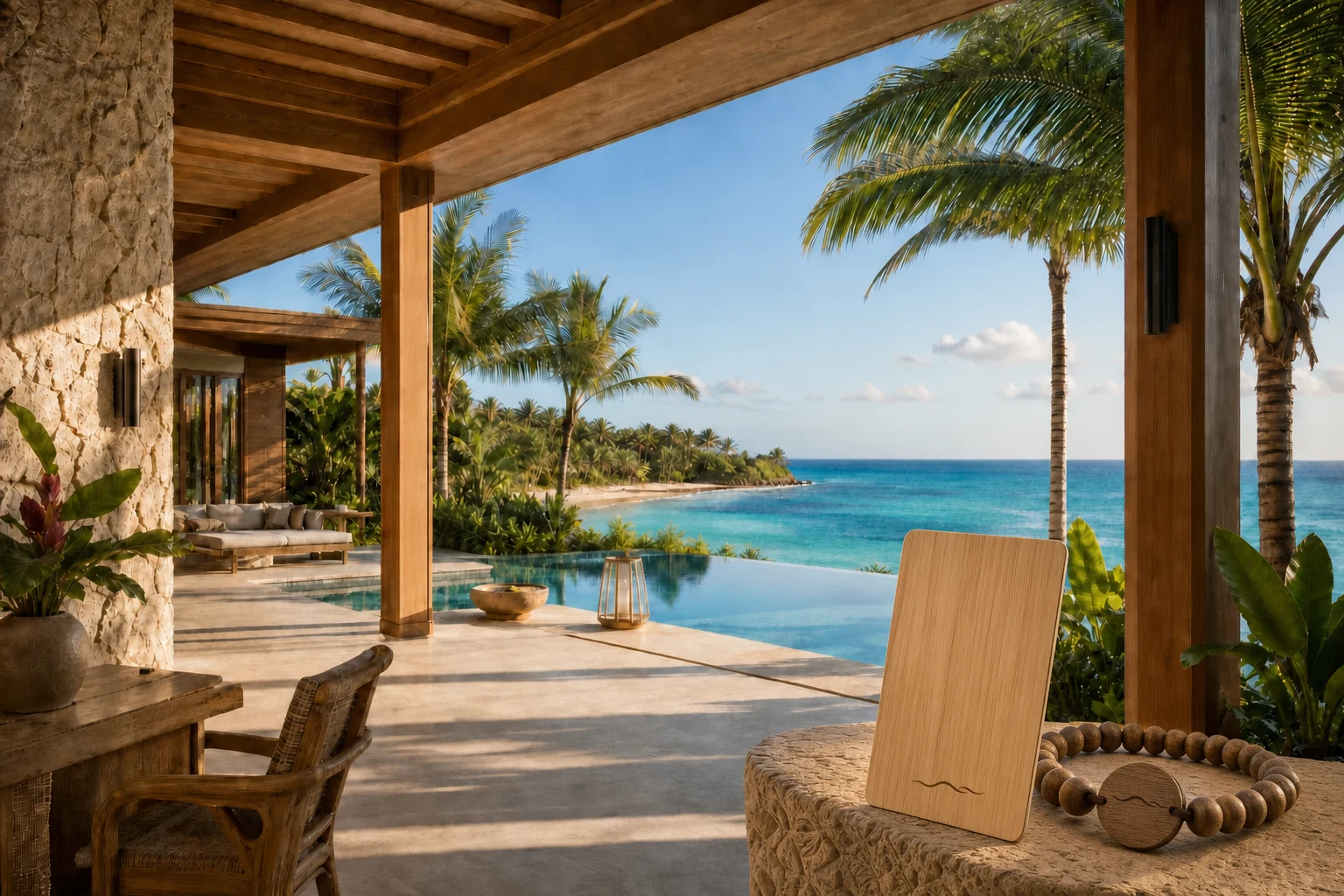
Keepsake-grade materials at low volumes
Artwork stability so one run covers a long period
Villa and suite credentials distinct from room stock
Operating reality
Product and specification decisions follow how the island's properties actually run.
A wood or bead credential intended to be kept, matched to the property's arrival experience.
A separate construction from general room stock, ordered on its own cycle.
A soft band for treatment areas where a rigid card is impractical.
One design held stable so a single run covers a long period without a reorder.
RFID products
We treat villa, suite and general room credentials as deliberate product families, limiting variants so the 500-piece design minimum remains operationally useful.
We manufacture Turks and Caicos RFID key cards for properties that want the arrival object to carry material character without losing technical control. A wood card, recycled-content PVC card or plant-based body is approved as a physical sample with its actual edge, finish and artwork—not as a generic sustainability promise. When the system uses CR80, the finished format is 85.6 × 54 mm and 0.76 mm. We confirm whether the credential is 125 kHz LF or 13.56 MHz HF/NFC before releasing the design. Villa, suite and room variants share a master visual system, while numbering or a restrained mark creates only the distinctions the issue desk genuinely needs.
We produce Turks and Caicos RFID wristbands where the credential moves beyond the room into pools, spas or beach facilities. Silicone is the clear wet-use direction; wood-bead and textile bodies suit a keepsake or wellness brief only after closure, comfort and reader presentation are tested. The RFID component, decorative body and branding are approved together because a visually refined band that presents inconsistently is not an acceptable product. A separate suite or villa wristband design must justify its own 500-piece minimum. Where colour or numbering can create the required distinction within one approved design, unnecessary variants are the wrong production choice.
Compatibility and encoding remain conditional on the installed system and the approved working sample.
Detail
When a property issues a modest credential population, every approved design remains in stock longer. That makes material character, artwork stability and the distinction between villa, suite and general room stock more important than multiplying decorative variants. Wood, cork and bead constructions can support a keepsake direction, but only when the property intends the guest to retain the object and the installed access system has been confirmed against the actual construction.
With a 500-piece minimum per design, the decisive question is how many designs the property can use without leaving obsolete stock. Villa, suite and general room credentials should separate only where the issue process needs that distinction. A seasonal colour change that serves no operational purpose creates another production record and another stock population. We settle the artwork hierarchy before quotation so the order reflects products the property can continue issuing consistently.
Wood and bead credentials get kept, and a property should decide whether that is the intention. If it is, the credential is a marketing item with a known non-return rate and should be ordered as one. If it is not, a returnable construction for general stock and a keepsake for suites is the usual split.
Technical depth
These are manufacturing controls, not assumed functions of a hotel system.
A villa, small hotel and larger resort can present the same guest promise while using different readers, encoders and issue routines. We therefore do not turn a shared logo into one assumed credential. Each installed-system group supplies a working reference or accountable technical record, and each production sample is tested in that environment. If two sites prove the same requirement, they may share a body and artwork; if they do not, their products stay separate. The distinction is recorded before quantity planning, because every approved design carries a 500-piece minimum and visually identical but electronically different stock is difficult to control.
Smaller accommodation providers may consume card stock slowly, which makes artwork stability and storage discipline more important than frequent redesign. The reorder record preserves body construction, finished size, RFID requirement, artwork revision, variable-data range and packing label. Cards remain dry, flat and separated from obsolete versions; wristbands are stored by closure and colourway. A future order begins from the retained approved sample, not from a generic product name. This is manufacturer-side continuity: it does not promise local inventory, transport timing or system support, but it greatly reduces the risk of ordering a physically different credential by description.
Market updateTurks and Caicos accommodation: RFID across property types ↗
Wrong fit
Frequent decorative variants are wrong for a Turks and Caicos property with a modest credential population. A keepsake body is also wrong when the property expects every credential to be returned and reissued. Material character must follow the intended retention and access routine.
Confirm the product ↗Build the brief
Share the property, destination, product direction and any system information already available. The secure form sends the brief directly to our manufacturing team, with the product, quantity and system notes kept together for review.
Plan the order ↗