Residence owners
A durable, understated credential intended to last years rather than a stay, often without visible property branding.
Island / Cayman
Cayman's accommodation mix leans heavily on condo-resorts and private residences alongside conventional hotels. That produces a credential population split between transient guests and long-term owners, and the two want very different objects.
Resident and guest credentials treated as separate products
Discreet branding for owner-facing credentials
Long-life materials for permanent holders
Operating reality
Product and specification decisions follow how the island's properties actually run.
A durable, understated credential intended to last years rather than a stay, often without visible property branding.
Standard room stock issued and recovered on the usual cycle, distinct from the owner credential.
One credential family covering pool, gym, beach and parking across a mixed-ownership building.
A clearly separate credential that reads as operational rather than guest-facing.
RFID products
Mixed ownership requires separate production records. We do not collapse permanent owner cards, rental stock, amenity wristbands and staff credentials into one generic design.
We manufacture Cayman Islands RFID key cards as at least two controlled populations where residences and transient accommodation share a system. Owner cards use restrained artwork, a deliberate reverse face and a numbering range that remains identifiable over repeated use. Rental cards can use a clearer property-facing design and a separate issue sequence. When CR80 is the accepted format, the body is 85.6 × 54 mm and 0.76 mm. Both populations still require the same technical discipline: confirm 125 kHz LF or 13.56 MHz HF/NFC from a working credential, test the approved sample, and record encoding ownership before the order is released.
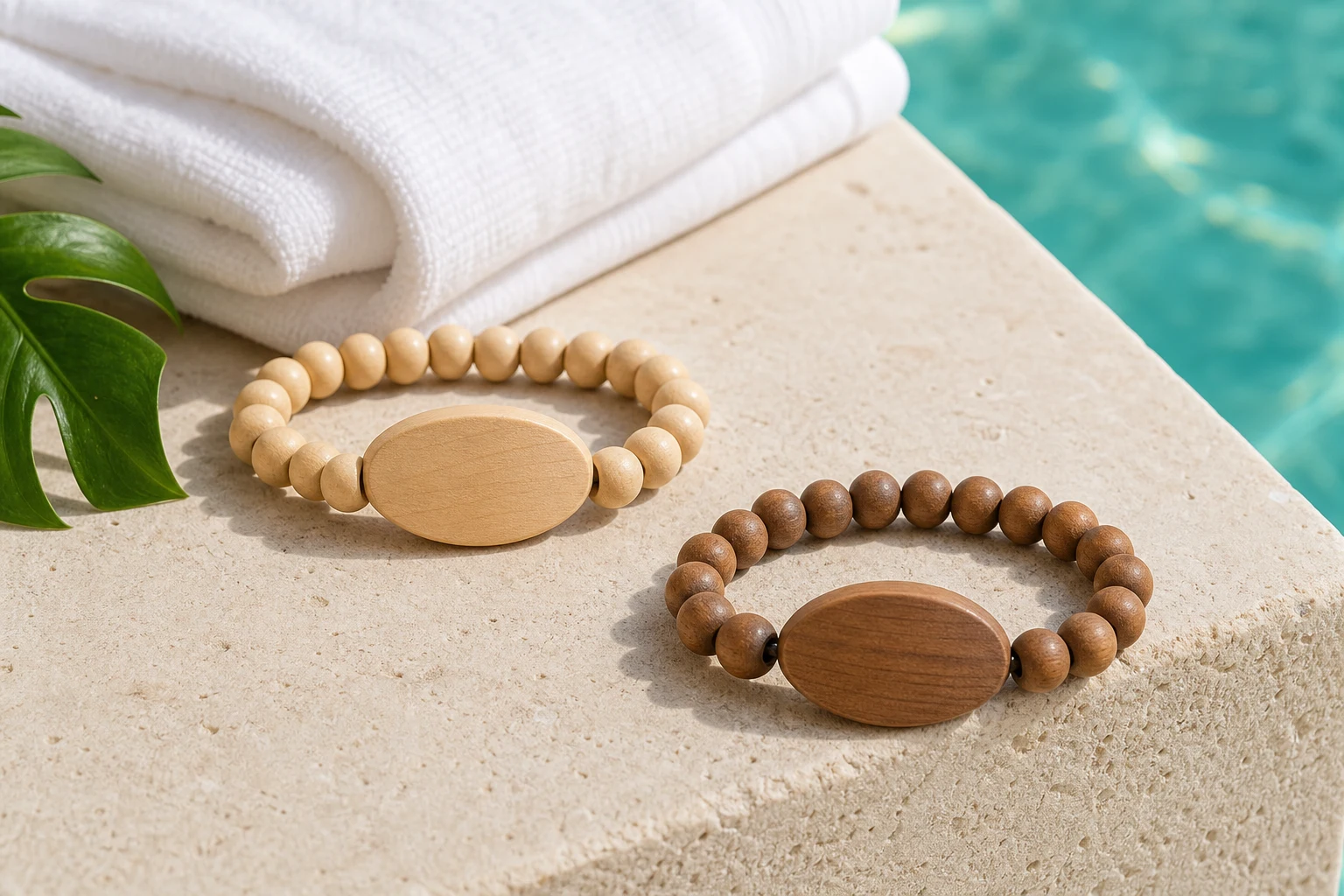
We produce Cayman Islands RFID wristbands for pools, gyms, beach areas and other shared amenities where a wearable is easier to present than an owner or room card. Silicone fits repeated wet use; wood-bead or textile constructions belong only where their wear, closure and presentation match the facility. A wristband may share visual elements with the card family while remaining a distinct manufactured product with its own RFID placement, artwork and numbering decision. Resident and short-stay bands should not become visually interchangeable merely because they reach the same reader. The 500-piece minimum applies per design, so unnecessary owner, guest and staff variants create avoidable stock fragmentation.
Compatibility and encoding remain conditional on the installed system and the approved working sample.
Detail
A card issued to somebody who owns the unit is retained rather than returned at checkout. It should be specified accordingly: a construction and surface approved for repeated handling, and usually far less branding than transient room stock. Wood or a restrained recycled-content card can carry that brief, but the decision remains tied to the installed system and the approved sample rather than to a claim that one body is universally more durable.
In a building where some units are rented nightly and others are owner-occupied, the credential population is not uniform and never fully turns over. A numbering scheme that separates permanent holders from transient stock — rather than one continuous sequence — is what lets a building audit its credentials without physically collecting them.
Where a resort wants its mark on everything, a residence usually wants the opposite. We routinely produce owner credentials with a small engraved building mark and nothing else, and put the operational information on the reverse where only the holder and the management office see it.
Technical depth
These are manufacturing controls, not assumed functions of a hotel system.
An owner credential may remain active for years, while rental stock is issued, cancelled and replaced around stays. The physical products may share a credential technology, but their visible and variable records should not be interchangeable. We can manufacture separate number ranges, restrained owner artwork and clearly guest-facing room stock, with each design approved independently. The property remains responsible for permissions and activation. Our production record covers what can be inspected: card or band body, 125 kHz LF or 13.56 MHz HF/NFC requirement, numbering, finish, artwork revision, quantity, packing sequence and the retained reference sample.
Pool, gym or beach access may justify a wristband when owners and guests repeatedly use shared amenities. Before recommending one, we ask who keeps it, whether it is returned, how long it is worn, how it is cleaned and how a lost item is disabled in the property system. Silicone can fit repeated wet use; a textile or bead construction needs its own moisture, comfort and retention review. If the property cannot define custody or replacement, adding a wearable creates another uncontrolled credential population. A card remains the better product until the operating rule is settled.
Market updateCayman room growth: owner and guest RFID control ↗
Wrong fit
One highly branded credential is wrong for every Cayman holder. Owners, rental guests, staff and amenity users have different retention and presentation patterns. A keepsake-style body is also wrong for transient stock when the property expects rapid return, replacement and visual reconciliation.
Confirm the product ↗Build the brief
Share the property, destination, product direction and any system information already available. The secure form sends the brief directly to our manufacturing team, with the product, quantity and system notes kept together for review.
Plan the order ↗